Replacing a Faulty Hall Sensor Cable

(Cause of No-Start)
1987 740 turbo, LH-Jetronic 2.2, EZ 117K Ignition System
One of the causes of a no-start is a faulty Hall sensor. That
fault can arise from a short circuit in the Hall cable, due to
worn insulation on the hot wires of the Hall plug. A short circuit
in the Hall plug will "fry" the Hall sensor, necessitating
a new Hall sensor and a fix of the short circuit. These
instructions give you step-by-step instructions on replacing the
Hall cable.
|
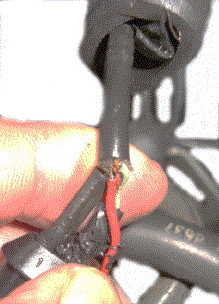
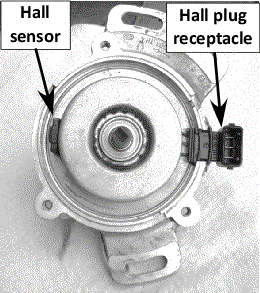
Symptoms: Engine hiccupped, then intermittently died over a period of months. Sometimes it restarted right away, other times not. Eventually engine stayed dead (but cranked). Ran tests. Got 0.25 VDC at ignition “On,” instead of 12 VDC, when testing #3 red wire of Hall plug. Found bare hot wires in Hall plug (Figure 1), which caused a short circuit. What caused worn insulation? Engine heat and lots of oil leaking past large O-ring of distributor into and around Hall plug. Result: The short circuit will have killed the Hall sensor (Figure 2), necessitating a replacement Hall sensor and a fix of the short circuit. One Solution for short circuit: Replace the Hall cable, which runs
from the distributor to the Ignition Control Unit (ICU). Wires! Wires! Everywhere! This difficult task involves
working in cramped spaces and contorting your body underneath
the dash to isolate and free the Hall cable. Not easy! If you do attempt such a splice, you need to splice each of the 3 wires and then insulate each wire splice. Next, I suggest wrapping medium weight tin foil at least twice around the length of the whole splice (all 3 wires) and overlap the stock shielding, say 1 1/2 inches or so, then having heat shrink insulation over and beyond the whole splice. Be sure you insert the heat shrink tubing on each wire and the whole cable and slide it out of the way before doing each splice. Let me know if this works! If it doesn't, you have no recourse but to replace the whole Hall plug cable. |
|
Such a time would be replacing the Hall cable that runs from the distributor alongside and through the firewall to the ICU under the driver’s side dashboard (above the gas pedal). |
If you wish to replace the Hall
cable in your car, then download the instructions, "Replacing
a Faulty Hall Sensor Cable."